
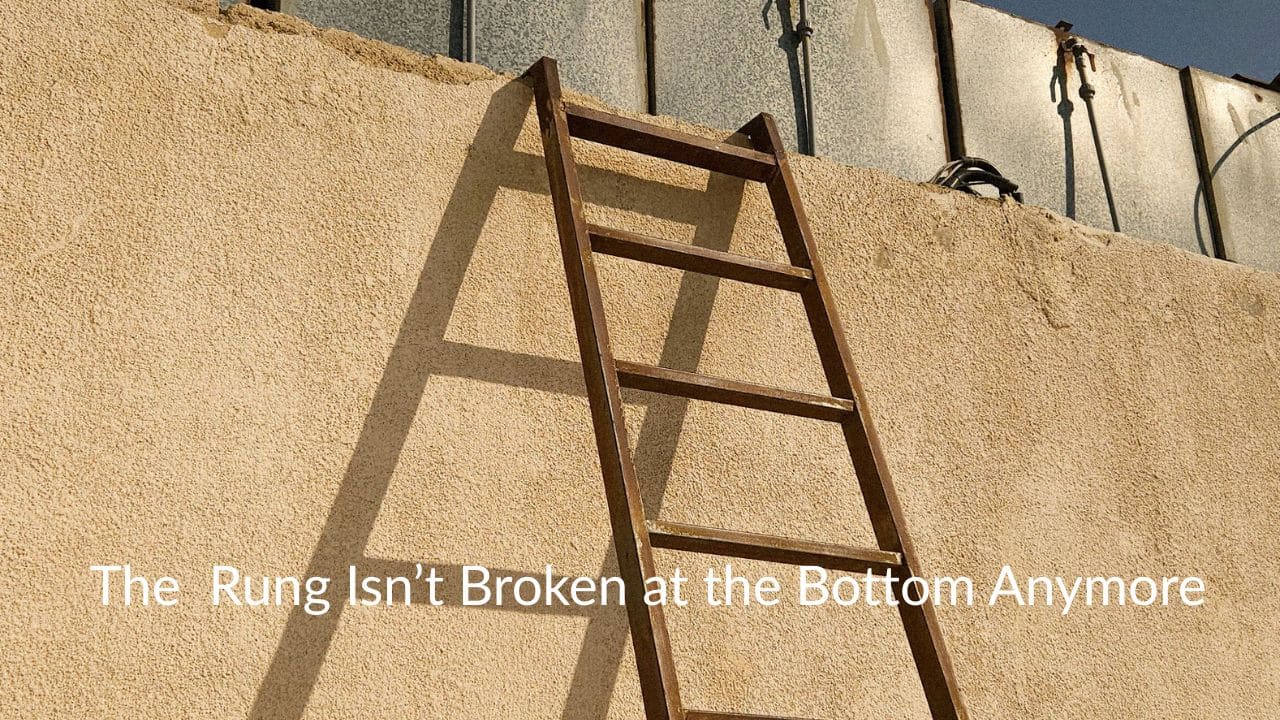
The rung isn’t broken at the bottom anymore.
It’s breaking in the middle — and everyone in the room is helping it happen.
For years, McKinsey’s Women in the Workplace report told a familiar story.
Fewer women than men advancing into leadership. The gap opening early and widening from there.
The 2025 report contains a finding worth acknowledging. At entry level, women now represent 49% of leaders. Parity, very nearly, at the first rung.
And yet by the C-suite, that figure is 29%.
The pipeline is still narrowing. Sharply. Somewhere between manager and the top, women are being squeezed out. The rung isn’t broken where it used to be. It’s breaking in the middle — at the Director and VP levels — and it’s breaking quietly, without drama, in ways that are almost impossible to see from inside the system producing them.
For years the explanation was ambition. Women, at a certain point, simply want less.
McKinsey’s 2025 data ends that argument. Where support exists — sponsors, mentors, stretch opportunities — women are exactly as ambitious as their male counterparts. The ambition was never the problem. The environment was.
That is the process answer. Change the support structures, and more women advance. It is true. It is also incomplete.
Because underneath the process problem is a belief problem. And it is running in three places simultaneously.
Inside the woman.
She believes her good work speaks for itself. Partly it does. Partly it doesn’t. She waits until she is certain she is ready before putting herself forward — which means she waits longer than her male colleague, who was encouraged to stretch before he was ready. She works twice as hard to prove a capability he was assumed to have. She has learned, from years of navigating a system not designed for her, that the rules require more from her than from him. She is right. They do.
Inside her decision makers.
They can see she is good at her current level. They are less certain she is ready for the next. She isn’t promoting herself. Isn’t demonstrating next-level readiness in the ways they recognise. Her male colleague, meanwhile, shows potential, and potential, in most organisations, is enough. He gets the stretch assignment. She gets the feedback to keep doing what she’s doing.
Nobody in this scenario is acting with malice. They are acting on a set of inherited assumptions about what leadership looks like, sounds like, and is associated with. Assumptions that have never been examined because they have never needed to be.
Inside the culture.
Underneath everything is a set of unspoken beliefs running through the organisation like a current nobody can see. That leadership is strong, decisive, direct. That it looks a certain way. That it is, more often than not, associated with a certain kind of person.
These beliefs were not written down anywhere. They were absorbed — by the women navigating the system, by the decision makers operating within it, by the culture reproducing itself generation after generation. They feel like facts because they have been treated as facts for long enough to become invisible.
The broken rung is not a process failure. It is the entirely predictable output of a culture built on unexamined assumptions. It cannot produce anything else — until those assumptions are brought into the light and looked at honestly.
The good news is that this is beginning to happen. Slowly, imperfectly, in organisations willing to ask harder questions than the process fixes require.
The rung can be repaired. But not from the outside in.

Leave a Reply
You must be logged in to post a comment.